

Solar Quote
See how much you could save by going solar

JinkoSolar: High-Performing, USA Made Solar Panels

JinkoSolar Holding Co., Ltd. is a solar panel manufacturer headquartered in Shanghai, China. The company was founded in 2006, in 2010 it became publicly traded on the New York Stock Exchange (NYSE: JKS).
Jinko Solar is a Silicon Module Super League member and manufactures a variety of solar products while maintaining 14 production facilities globally with a distribution network delivering residential, commercial and utility scale projects around the world.
Jinko Solar has international sales teams in China, the United States, Canada, Germany, Switzerland, Italy, Japan, Australia, Korea, India, Turkey, Chile, Brazil, Mexico and Hong Kong, supporting international subsidiaries in Japan, South Korea, Vietnam, India, Turkey, Germany, Italy, Switzerland, the United States, Mexico, Brazil, Chile, Australia, Canada, Malaysia, UAE, and Denmark. Jinko Solar employs more than 12,000 employees worldwide
On January 8th 2021, a report was released by Horizon Advisory that analyzed geopolitical trends assessing the commercial and security implications of China’s approach to global competition. In this report, Jinko Solar was named as among Chinese companies believed to use Uyghur forced laborers in their manufacturing process.
After conducting an in-house review disputing the Horizon report, Jinko Solar spokesperson Ian McCaleb stated that JinkoSolar “found that they do not demonstrate forced labor in our facilities. . . Strongly condemns the use of forced labor and does not engage in it in its hiring practices or workplace operations.”
Easing the concerns of US solar consumers, JinkoSolar opened a state-of-the-art plant in Jacksonville, Florida.
Jinko Solar Panels will now have the proud distinction of being Made in the USA.
Jinko Solar Has a Dedicated Warehouse and Shipping Facilities Located in Houston, TX
In response to continued U.S. demand, Jinko built its first factory in the United States. The $50.5 million Jacksonville, Florida facility employs 280 local workers in one of the most advanced, fully automated solar assembly plants on the planet.
US assembled JinkoSolar modules are exempt from Section 201 import tariffs imposed on foreign made components by President Trump. Additionally, American made JinkoSolar is compliant with the American Recovery and Reinvestment Act as well as the Buy American Act. The new plant allows JinkoSolar to produce a full line up of tariff-free solar modules for the US consumer.
We will look closely at JinkoSolar Eagle 72HM G2 JKM400M module.
JinkoSolar has been recognized as an "Overall High Achiever" in Renewable Energy Testing Center’s ("RETC") 2021 PV Module Index Report for the second consecutive year. JinkoSolar is one of only 5 module manufacturers to receive this status in 2021.
Rigorous in-house quality control standards and validation from third-party labs, such as RETC, gives customers around the globe confidence in choosing JinkoSolar modules.
Jinko Solar Panels by the numbers
JinkoSolar offers solar panels suited for a variety of applications, including residential off grid systems, as well as more common grid-tied systems.
JinkoSolar Eagle series features 144 PERC monocrystalline half cells. While you can see information on several Jinko Solar models on the spec sheet, we will focus on the JinkoSolar Eagle 72HM G2 JKM400M, a model you are most likely to encounter in the Texas residential solar market.
Eagle G2 JKM400M-72HL-V modules consist of half-cut Diamond cells. These uniquely designed cells feature high-efficiency mono PERC technology. Half cell modules have twin arrays and thus increase tolerance to shade. There’s also less current loss, for higher module power.
Jinko Solar has a strategic relationship with DuPont™, the inventor of Kevlar, to incorporate its strong, durable Tedlar material into every one of Jinko's Eagle G2 module back sheets. Tedlar is the only material proven to last more than 30 years in the field. Because back sheet failures represent a large problem in the field, many customers insist on Jinko Solar due to the proven materials they use.
JinkoSolar Eagle 72HM G2 JKM400M
The JinkoSolar Eagle 72HM G2 JKM400M module has a power max output rating of 400 W. These 144 5-busbar Diamond Mono PERC half-cell modules have a traditional black background featuring silver cell divisions, giving these panels a classic solar aesthetic on the roof. In independent third-party testing, Eagle 72HM G2 JKM400M models test at or above their reported electrical output. Some panels produced as much as 3% over their reported rating. The report showed that some of these 400-watt panels tested near or at 412W production potential level. This is not only especially encouraging for overall electricity production but in consideration of future rates of degradation.
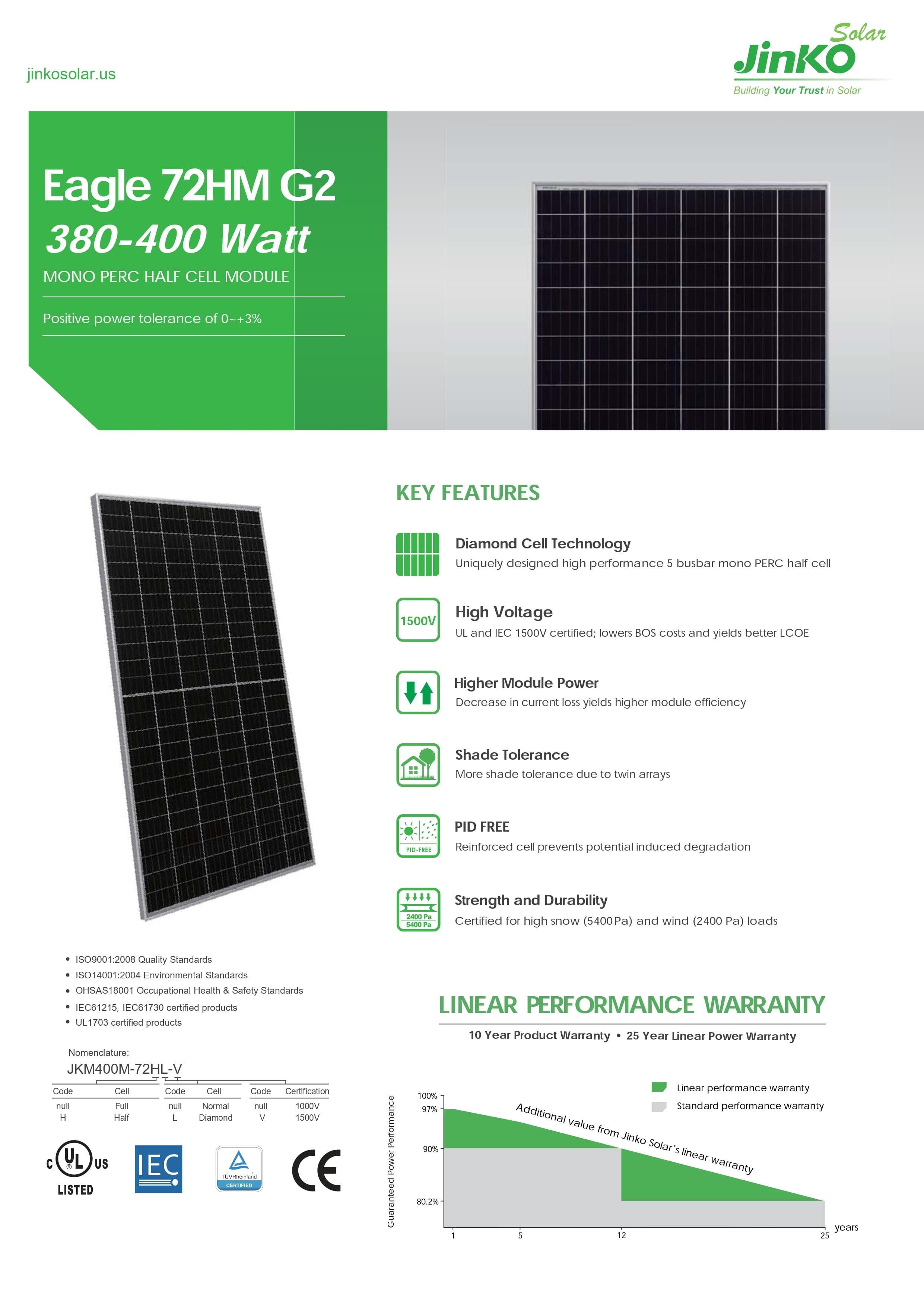
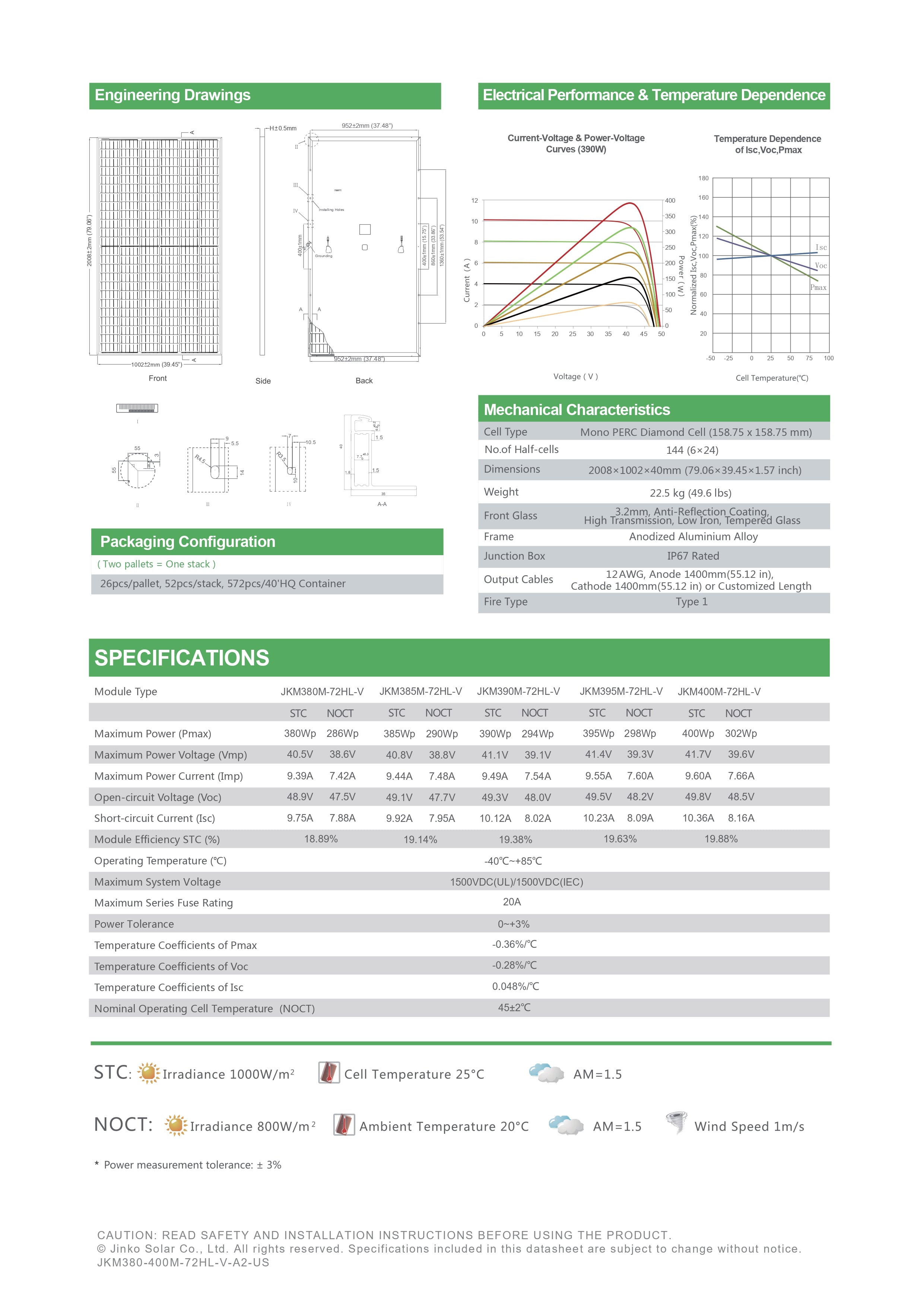
The Eagle 72HM G2 JKM400M has limited power degradation and is guaranteed to retain 97% of the original capacity during the first year, 90% capacity at 12 years, and 80.2% of its original capacity at 25 years.

Specification
Power output
Efficiency rating
Cell Type
Power Tolerance
Front & back load
Warranty
Jinko Solar Eagle 72HM G2JKM400M
400 W
19.88 %
MonoPERCDiamondCell
0 ~ +3%
5400 Pa-2400 Pa
25-year linear warranty
Enter Your Zip Code to Compare Quotes from Your Area
Enjoy our 100% online experience, or via phone if you prefer. Your choice.
JinkoSolar Efficiency
Solar panel “efficiency” is a measurement of a specific solar panel’s ability to convert sunlight into electricity. Hence, a more efficient panel will produce more electricity in a given amount of space compared to a panel with a lower efficiency rating.
JinkoSolar Eagle half cut 72 cell module’s efficiency ratings range between 18.89% and 19.88% putting them on the upper end of average solar panel efficiency. This efficiency rating are obtained by using high performance 5 bus bar mono PERC Diamond half cell technology.
JinkoSolar Power Tolerance Rating
Power tolerance refers to the amount of electricity it will produce either above or below its rated power capacity at Standard Test Conditions (STC). The smaller the power tolerance deviation or range, the more accurate the rated power capacity is.
JinkoSolar modules have a power tolerance of -0/+3%.
This means JinkoSolar panels will, at the very minimum, operate at their rated capacity, However, these panels have exceeded their rated capacity by as much as 3%.
For example, a JinkoSolar panel rated at 400 W will be able to operate anywhere from 400 W to 412W (or 3% higher than 400W) under STC.
With a -0% tolerance rating, the JinkoSolar Eagle 72HM G2 JKM400M panel operates at, or above 400 W. These performance scores make Jinko a solid consideration for value minded Texas solar consumers.
JinkoSolar Temperature Coefficient
Solar panels perform best at 77°F (25°C). Here in Texas, obviously, we see temperatures that far exceed 77°F for long portions of the year. A solar panel’s temperature coefficient is a measurement indicating how well a specific model of solar panel will perform outside of ideal operating conditions.
Knowing a panel’s temperature coefficient and the temperature of the panel will allow you to predict your panel’s performance during the dog days of summer.
Temperature coefficients are calculated in Celsius.
With each degree above 25° C /77° F, a given solar panel’s electric output will be diminished by its temperature coefficient.
Using the above methodology, the JinkoSolar Eagle 72HM G2 JKM400M panel has a temperature coefficient of 0.35%/°C. Hence, when this panel’s temperature increases by one degree, from 25°C to 26°C (77° F to 79° F), expect a 0.35% reduction in potential electric output.
When it's July in Texas and temperatures have climbed to 95° F/35° C, expect electric output to decrease by 3.5%. When the hottest hours of the summer drives the mercury into the triple digits, say 113° F/ 45° C, the JinkoSolar Eagle 72HM G2 JKM400M will decrease approximately 7.0%.
JinkoSolar Performance Factors
Renewable Energy Test Center (RETC), a leading independent lab for testing photovoltaic (PV) and battery products, released its 2022 PV Module Index (PVMI) report highlighting module performance. Specifically, RETC is interested in forensic analysis of PV systems
Based on available testing data, RETC noted Jinko Solar as one of the overall top performers
The Renewable Energy Test Center awarded JinkoSolar panels (assembled in Florida) high marks in the categories of:
- Hail durability
- Light Induced Degradation(LID) resistance
- LeTID resistance
- Pan file performance
- Dynamic mechanical load test
- PID resistance
- Thermal cycle test
High performing panels earn high test scores. It is no wonder that one out of every ten panels in the world was made by Jinko Solar.
PVEL’s independent lab and field-testing assembles data that developers use to get reliable solar equipment, which allows performance forecasting with a strong degree of accuracy.
In the 9th Edition of PVEL’s PV Module Reliability testing (2022), Jinko Solar made the 8X Top Performer , being awarded the distinction in 2014, 2016, 2017, 2018, 2019, 2020, 2021 and 2022.

Warranty JinkoSolar Panel
JinkoSolar panel offers a linear production warranty 25-year guaranteeing the panel will retain 82.1 % of its original capacity through the end of the 25th year, and a 10-year product warranty on every panel they manufacture.
The warranty ensures all solar panels to be defect free and with normal use and proper installation for 10 years from date of purchase.
JinkoSolar Energy Key Features
- JinkoSolar Energy is a global solar panel manufacturer headquartered in Shanghai China i.
- Fire Type 1 rated module engineered with a thick frame, 3.2 mm front side glass, and thick back sheet for added durability
- JinkoSolar’s panels are constructed of record efficiency setting, Diamond Half Cell Technology mono PERC cells which deliver a lot of power in a small footprint .
- Jinko Solar has Excellent performance in low-light environments. Their twin array design allows continued performance even with shading by trees or debris
- Certified for high snow and wind loads
- Certified to withstand humidity, heat, rain, marine environments, wind, hailstorms, and packed snow (45 mm Hailstones at 29 m/s)
- You can expect to pay around $.72 per watt pre-installation for JinkoSolar panels, which is a value in the Tier 1 class.
- 25-year linear warranty.
Frequently Asked Questions
Jinko solar panels are known for their high efficiency, reliability, and performance. They use advanced technology and undergo rigorous testing to ensure optimal energy production.
Jinko offers a range of solar panels with varying efficiency levels. Generally, their panels have efficiency rates between 17% to 20%, depending on the specific model.
Yes, Jinko solar panels are commonly used for residential installations. Their efficiency and compact size make them a popular choice for homeowners.
Yes, Jinko provides a solar warranty on their solar panels. The warranty period can vary depending on the model, but it typically covers a period of 10 to 25 years.
Jinko uses both monocrystalline and polycrystalline technologies in their solar panels. Monocrystalline panels are known for their higher efficiency, while polycrystalline panels are generally more affordable.
Yes, Jinko solar panels are designed to be durable and can withstand various weather conditions, including high winds and heavy snow loads. They are built to be corrosion-resistant as well.
Yes, Jinko solar panels have been certified by various international organizations, including TÜV Rheinland, UL, and CE, among others. These certifications ensure compliance with industry standards.
Yes, it is recommended to have a professional solar installer set up your Jinko solar panels. Professional installation ensures optimal performance and adherence to safety guidelines.
Jinko solar panels require minimal maintenance. Regularly cleaning the panels with water and a soft cloth is usually sufficient to keep them operating efficiently.
The availability of incentives and rebates for installing Jinko solar panels may vary depending on your location. In some regions, you may be eligible for solar tax credits or other incentives to encourage solar adoption. It's best to check with local authorities or solar installers to learn about available incentives in your area.
Yes, Jinko solar panels can be used in conjunction with battery storage systems to store excess energy for later use. This helps increase energy independence and resilience.